Signalman’s House
The Michael King Writers Centre has called the Signalman's House home since the building's restoration for community use. Built in 1898 and perched on the slopes of Takarunga / Mt Victoria in Devonport, the house carries over a century of history. As the home and workplace of the signalmen, ships were guided into Auckland's harbour, to its current life as a place where writers come to work. This page traces that story: the maunga it stands on, the house itself, the signalmen who lived there, and their families who called it home.
Takarunga and the Signal Station
-
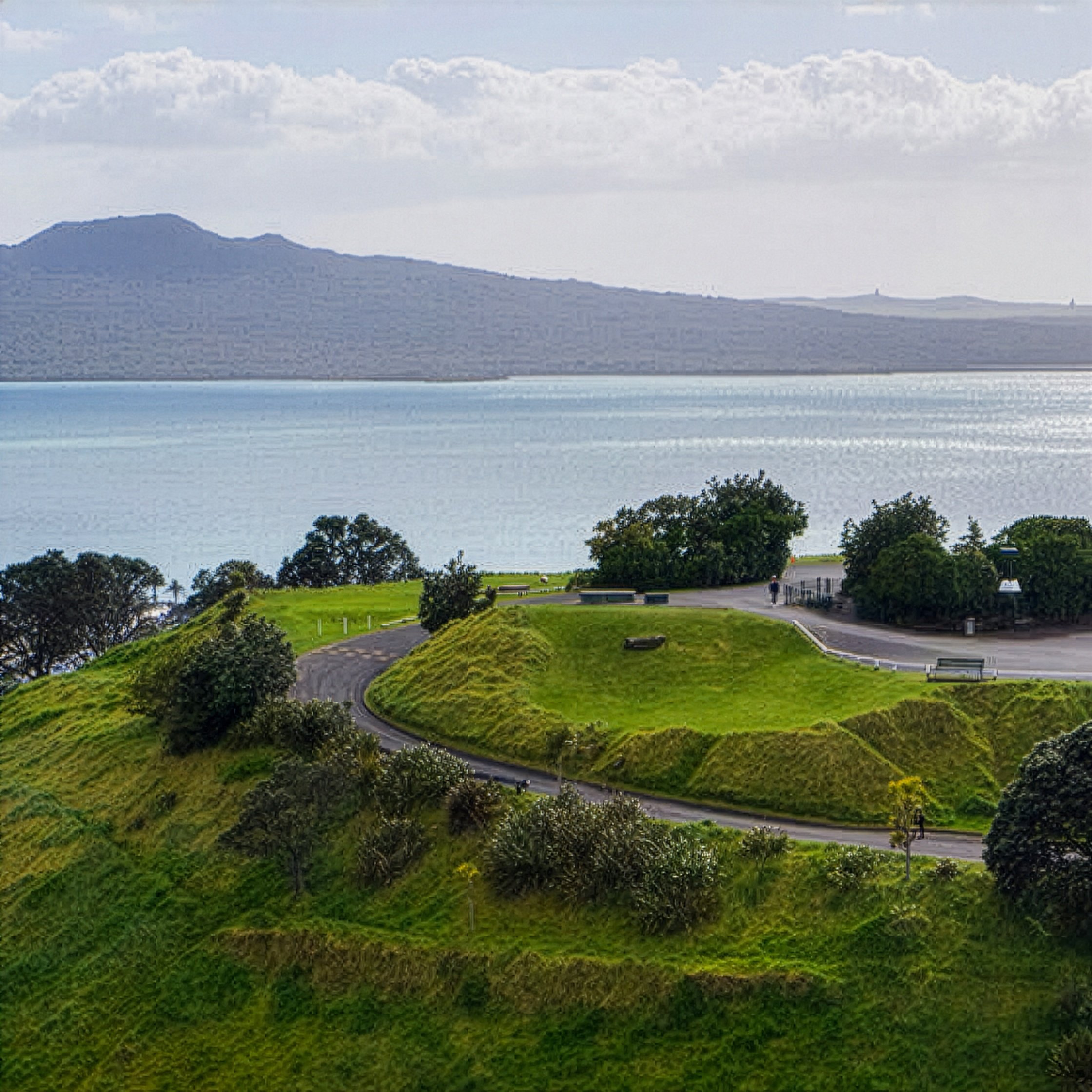
Takarunga is one of Auckland's 14 Tūpuna Maunga (ancestral mountains) and the highest volcanic cone on the North Shore, with a tihi (summit) of 66 metres.
Takarunga has a long Māori history and played a key role in the development of the Port of Auckland after Pakeha settlement. The name means "hill standing above." The mountain was once fortified and occupied by successive iwi over several centuries; terraces and pits from former dwelling areas and kumara storage are still visible on its northern and north-eastern slopes.
The Tūpuna Maunga o Tāmaki Makaurau Authority, established in 2014 under the Ngā Mana Whenua o Tāmaki Makaurau Collective Redress Act, is an independent co-governance entity that manages Auckland's 14 volcanic cones. It brings together Ngā Mana Whenua o Tāmaki Makaurau (the region's 13 iwi/hapū) and Auckland Council to oversee these sacred sites.
-
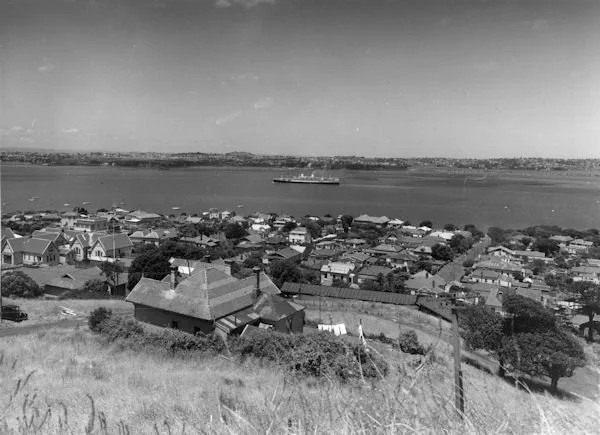
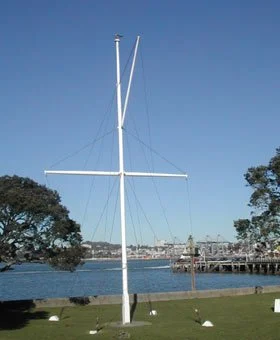
A signal station was established on the summit in 1842 to assist passing shipping, and colonists began calling Takarunga "Flagstaff Hill." Its sweeping views over the Waitemata Harbour and Hauraki Gulf made it ideal: ships could take up to three days to reach Auckland after first being sighted, so the station's signals, followed closely by residents and merchants, identified incoming vessels and guided them to port.
Flagstaff Hill became known as Mt Victoria in the 1840s and was declared a public reserve in 1880.
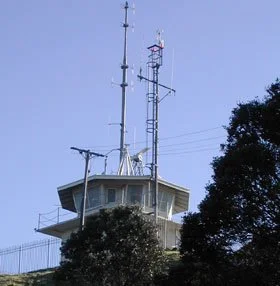
The signal station closed in January 1930 for reasons of economy, with operations moved to King's Wharf. When that wharf was dismantled in 1934, Takarunga again became Auckland's main signalling centre. A new signal station tower was built on the summit in 1954, and by 1970 radar with a 45-mile range had been installed. The station became fully automated in June 2000, with radar monitored remotely from the Ports of Auckland operations centre.
The whole of Takarunga is registered as an archaeological site under the Historic Places Act 1993, protecting it from modification, damage or destruction.
-
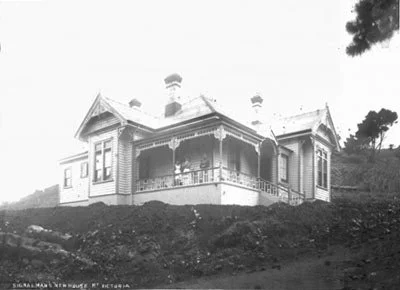
The first signalmen lived in a tent or raupo hut on the summit. After the mountain was fortified during the 1880s "Russian Scare" and taken over by the Defence Department, the Auckland Harbour Board decided in 1898 to build a proper house for the signalman, on the current site partway down the southern slope.
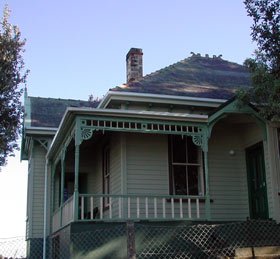
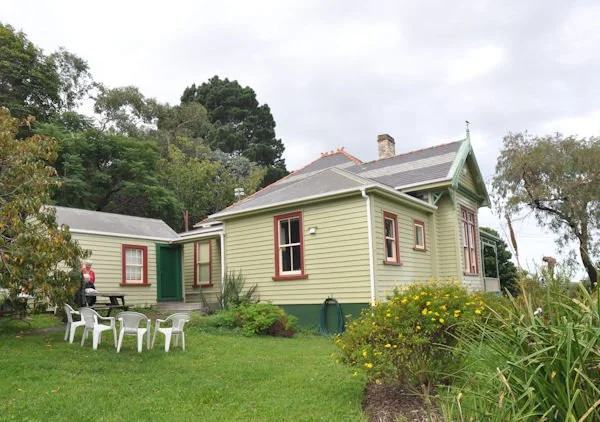
Architect Edward Bartley designed the house, built that same year in the style of a New Zealand Victorian "corner bay" villa, with some notable variations: a steeply pitched hip roof with fine slate and terracotta ridge capping, and a kitchen and bathroom roofed in matching hip and skillion forms rather than the usual lean-to.
A conservation report prepared before the house's renovation describes it as "a well-proportioned and elegant building" that shows Bartley's willingness to experiment within an accepted style, producing a design that stands apart from other villas of the period. At the rear, a lean-to verandah connects to the old wash-house, now converted into a writer's studio (the larger of two original outbuildings; the second no longer exists).
The report also notes the house's significance: as a surviving purpose-built dwelling tied to a 19th-century signal station, for its connection to the Auckland Harbour Board and the history of Devonport, for its links to people of historical interest, and for its value as both an interpretation of the villa style and a Devonport landmark.
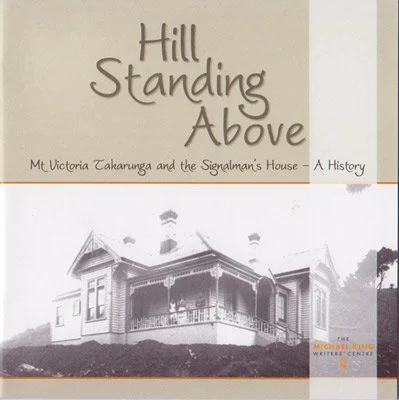
John Fisher was the first signalman to live in the house. The last was Arthur East, who died in 1943; his widow and family stayed until the 1960s, when the Harbour Board's lease expired. The Michael King Writers Centre has published a booklet on the history of the house and mountain, available for $10 including NZ postage by contacting the Centre.
-
Naval officer Lieutenant Robert Snow was appointed the first signalman in February 1842, also responsible for the naval stores depot. Boatman Gilbert Adams took over in 1842 and held the post until 1843, when poor eyesight forced him to stand down.
Thomas Duder, an Able Seaman from Devon who'd been shipwrecked off Mercury Bay on the HMS Buffalo in 1840, then became one of the longest-serving and best-known signalmen. In 1847 he was wrongly accused of murdering Robert Snow and his family; the real culprit, Joseph Burns, later confessed and was the first Pakeha hanged in New Zealand. Duder was cleared, went on to become a respected Devonport businessman with eight children, and has a local street named after him. He held the role until shortly before his death in 1875, aged 69, despite the Provincial Government refusing him a pension in his sixties.
A.J. Holland followed, then John Lander from 1880, a seafaring Kent native who'd arrived in New Zealand around 1834 and served the Harbour Board for 30 years. Captain John Fisher took over in 1893 after a decade as Harbourmaster, becoming the first occupant of the new Signalman's House in 1898; he held the post until his death in 1905.
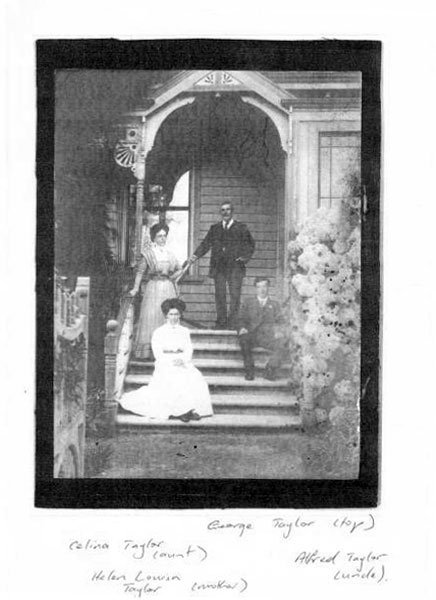
George Taylor followed, working an average 82.5 hours a week in his early years before an assistant signalman was appointed in 1912 (though not until after his retirement at 78). After 18 years' service he received a year's paid leave, a letter of appreciation and a marble clock from grateful ship owners.
Three signalmen then worked on a roster, including Arthur Young (1923 to 1931), followed by Harry Lappen in 1934 when the station reopened after the Depression. The last signalman to live in the house was Arthur East, appointed in 1934 and serving until his death in 1943 at 52. His widow remained in the house until 1968, when the Harbour Board's lease expired.
Memories of the Signalman's House
-
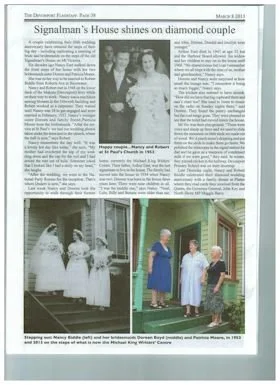
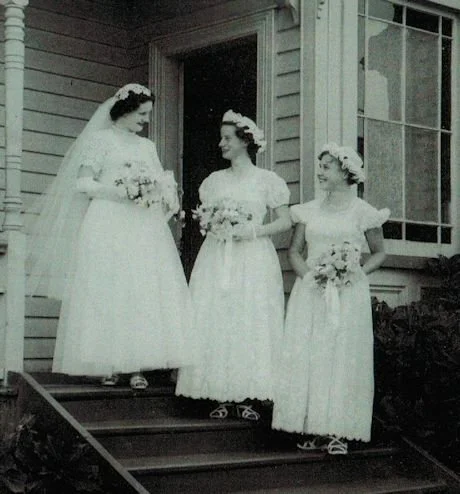
On 28 February 1953, Nancy East married Robert Biddle at St Paul's Presbyterian Church, Devonport. Nancy was one of nine children raised in the Signalman's House, where a wedding day photo was taken of Nancy and her bridesmaids, sister Doreen and friend Patricia Lound, on the front steps. Sixty years later the three women, with Robert, returned to recreate the photo.
Arthur East, the last signalman, moved into the house in July 1934 with his wife Emma and five children; four more followed, all born in the front bedroom. The family of nine children, plus East's mother-in-law Anna Scott, lived in the modest four-bedroom house.
Arthur East died in November 1943, aged 52. Emma was allowed to stay until December 1968.
-
Nancy was about two when the family moved in; her brother John was born just days earlier. The nine East children, Noel, Lulu, Billy, Bonnie, Nancy, John, Doreen, Jocelyn and Donald, all attended Devonport Primary and Takapuna Grammar.
Grandmother Anna, always dressed in black, did the family's grocery shopping down Calliope Road and carried it up the hill; the children nicknamed her "the witch of Devonport." Despite nine children, a grandmother and frequent long-staying visitors, the house never felt crowded. There was a coal range for cooking, unused fireplaces elsewhere, and a lounge kept "for best."
The children remember climbing to the Signal Station with their father, polishing the telescope with vinegar for a teaspoon of condensed milk, and watching the signal cones. Money was tight: clothes were hand-me-downs, and Saturday dinner was porridge and Sunshine soup.
During the war, an army camp operated down the hill and used the school's outbuildings; afterwards it became a transit camp. When Arthur East died, the army held a party for the children and drove them home in army trucks.
-
After marrying, Robert and Nancy lived briefly in Takapuna before moving back into the Signalman's House to help Emma East care for her large family and ailing mother. Their daughter Roseanne was born there.
The pair recall two outbuildings behind the house (a workshop next to the laundry, plus an outdoor toilet used right up until 1968), a tin coal shed, and a vegetable garden with a lilac tree where the driveway now sits. With fewer trees on the hill in those days, the view stretched all the way to the Navy base.
One memorable night, Robert found a man lurking behind the house. He turned out to be an escaped Australian prisoner. In 1957, Nancy nearly burned the house down when washing left by the fire caught alight; she put it out before it spread.
Emma East moved out in December 1968 and died in 1990, aged 89. Robert, a builder who later became Council building inspector, still lives with Nancy in their long-time Hauraki home.
-
Patricia was a bridesmaid because she worked alongside Nancy at Vanite Garments, a high-end blouse manufacturer set up by her mother in a flat below their home on Hauraki Road. Up to ten women worked there making blouses for shops including Smith and Caugheys, a major fashion item of the 1940s and 50s.
-
By Jack Roper, grandson of signalman George Taylor.
Roper recalls his mother's phrase "fleet weather," used to describe a perfect, cloudless day. She grew up in the Signalman's House while her father served as signal master, watching ship movements through a tripod telescope and directing them by flag, long before phones or radios.
The phrase traces back to 8 August 1908, during the "Russian Scare" that saw North Head fortified with gun emplacements, including a disappearing gun still on display today. To mark a goodwill visit from the United States Navy, a temporary rail link rushed dignitaries from Wellington to Auckland. On a brilliant, cloudless day, sixteen white ships, the Great White Fleet, sailed into the Waitemata Harbour, watched by a crowd of around 100,000. The memory stayed with Roper's mother for life: ever after, a perfect day was "fleet weather."